
Stories
Objects have a way of leading somewhere.
A shape, a material, an unexpected detail, a question I can't quite answer—sometimes that's all it takes to begin. These stories follow that curiosity: into art, design, history, making, collecting, and the people and ideas that connect them.
They are about looking closely, following what catches the imagination, and seeing where it leads. The excitement is in not knowing where that will be and enjoying the pleasure of the journey to the unknown destination.
Story - 01
What am I looking at?
This was before I was using Google Lens, when identifying an unfamiliar object meant first finding the words to describe it. And that was the problem: how do you describe something when you don't know what you're looking at?
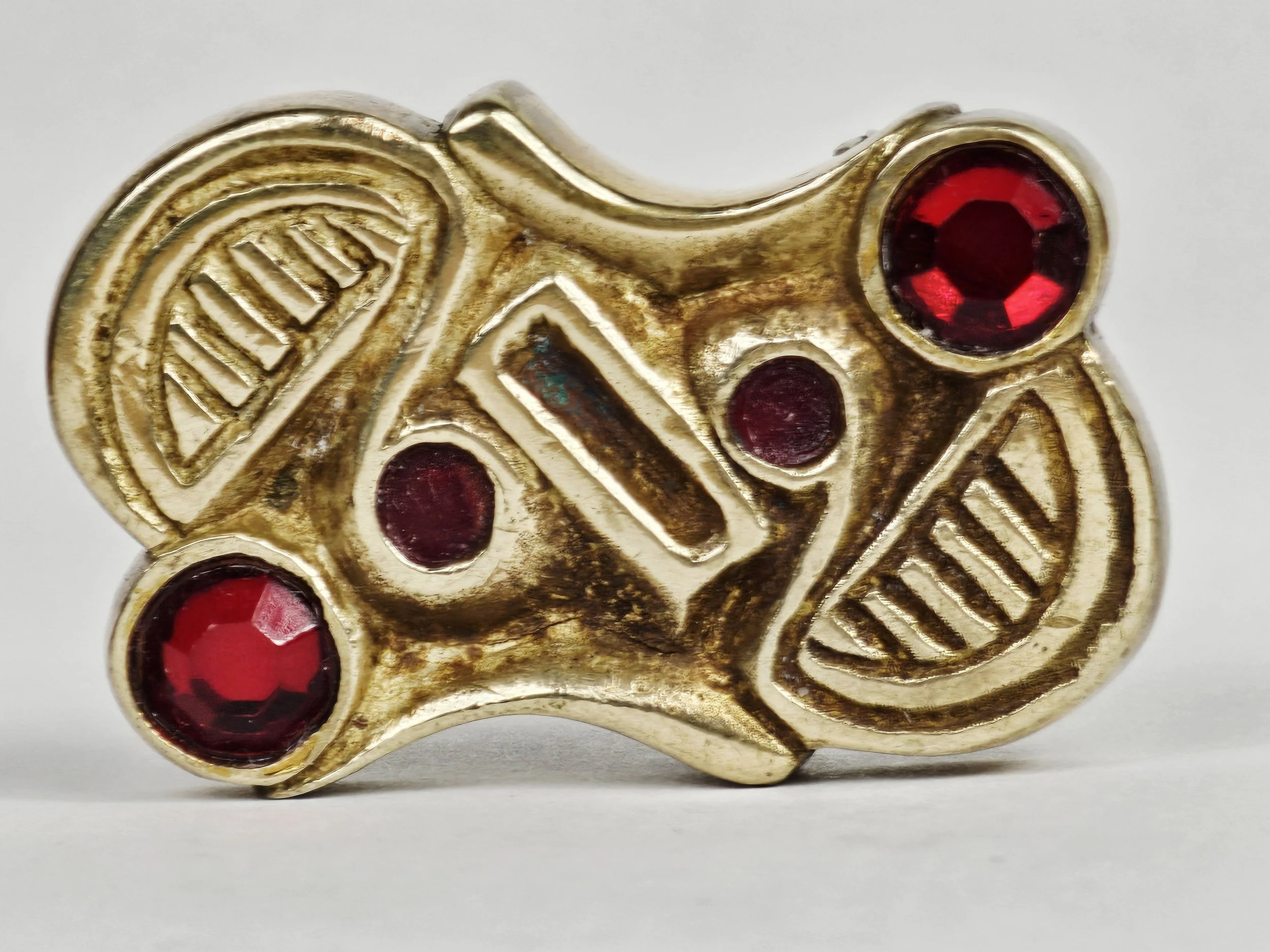
I tried. I searched through images. I changed the words and tried again. Eventually I became frustrated and threw up my hands. The brooch went onto a little shelf in my living room. I pass that shelf many times every day. Every so often I would pick up the brooch and roll it around in my hands. This is something. I still didn't know what.
By then, it was under my skin. I couldn't identify it, but I couldn't dismiss what I could see. There was too much intention in it. Too much design. It was too good to be arbitrary. Whatever I was looking at, somebody had thought very carefully about it. So it sat there. And every once in a while, it called me back.
Some objects can be identified quickly. Others can only be known slowly. For a while, the brooch existed in that suspended moment of possibility: I could see it without yet seeing what it was.
My Brooch
Seeing the birds
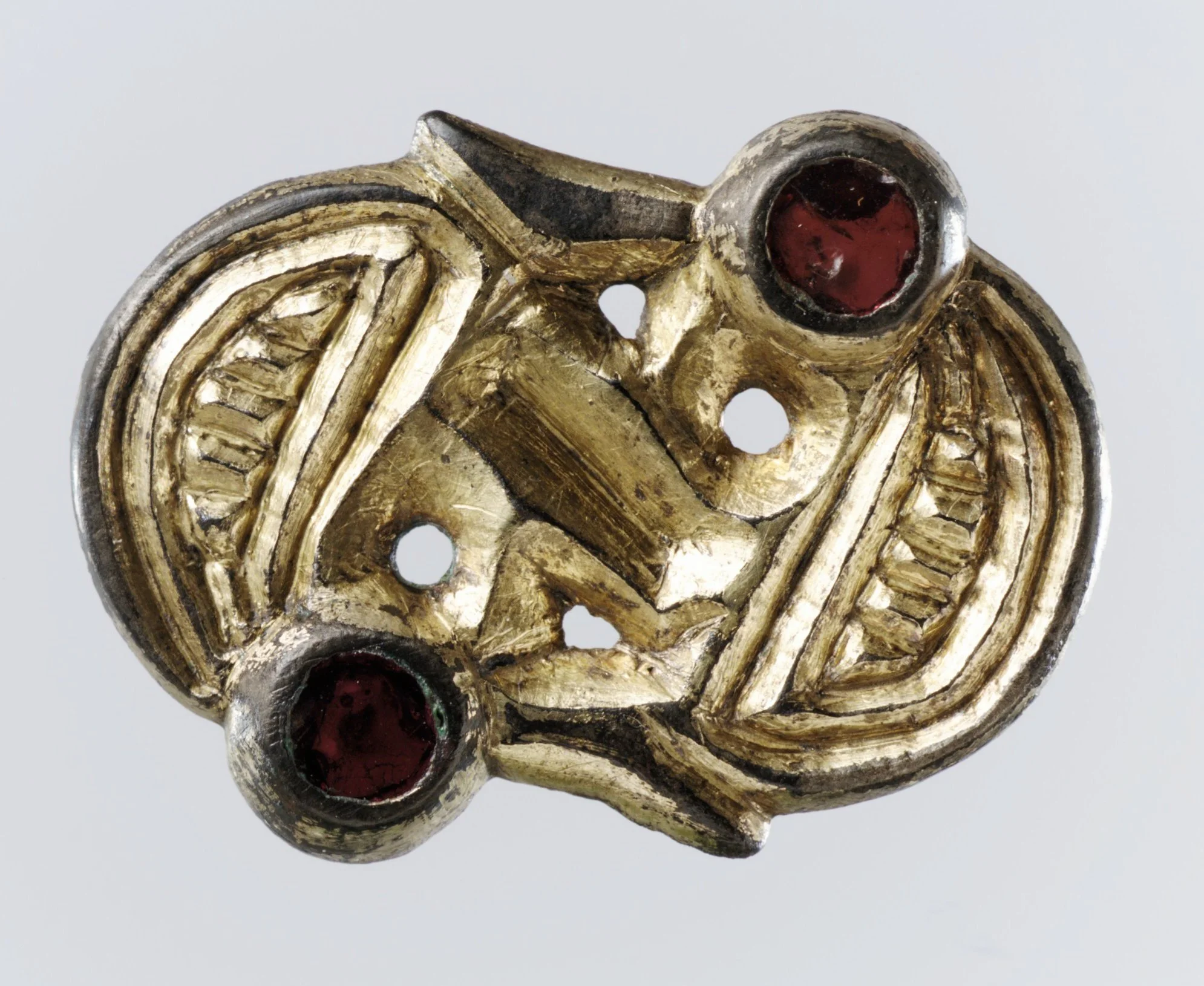
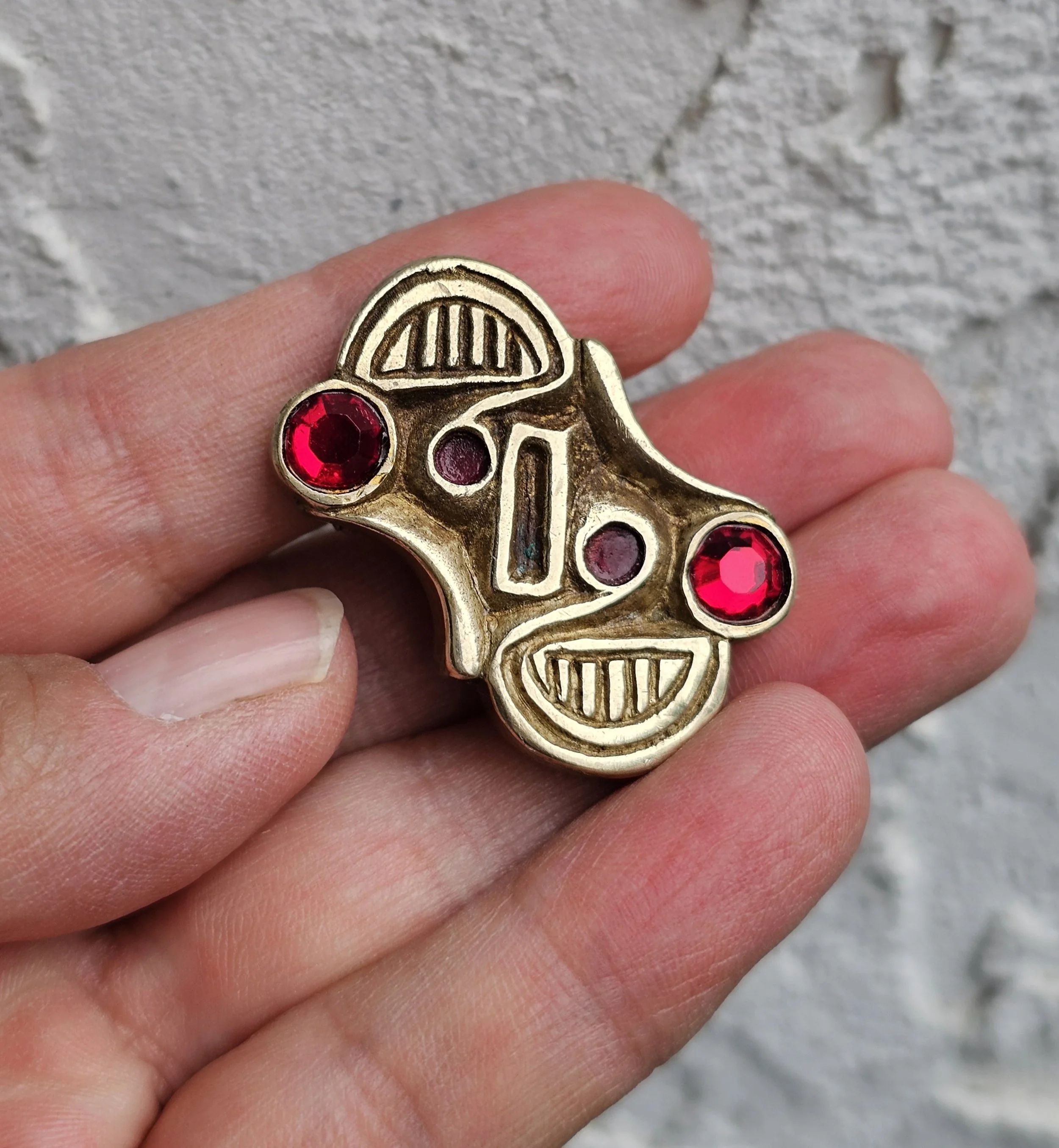
The Met brooch is made of silver and gilded silver, with garnets, niello inlay and an iron pin. It measures 1 9/16 × 1 1/8 × 3/8 inches. [1] Mine, measured rather less scientifically with a tape measure, is approximately 1⅜ × ⅞ × ¼ inches. They aren't identical in size, but they are remarkably close in scale. More importantly, the design is there.
The two opposing creatures. The large circular eyes. The ribbed curved forms. The smaller circular elements. The diagonal structure through the centre. Even tiny projections around the perimeter have their counterparts.
My brooch is not ancient. Its modern pin construction makes that clear, and its red stones are glass; some of the smaller depressions are filled with what appears to be enamel. It is a later interpretation of an ancient design. I have not yet established who made it or when. But someone, much later, looked very closely at this ancient design.
S-shaped Brooch, Frankish, 6th Century. Silver and gilded silver, garnets, niello inlay and iron pin. The Metropolitan Modern Art, New York. Public Domain [1]
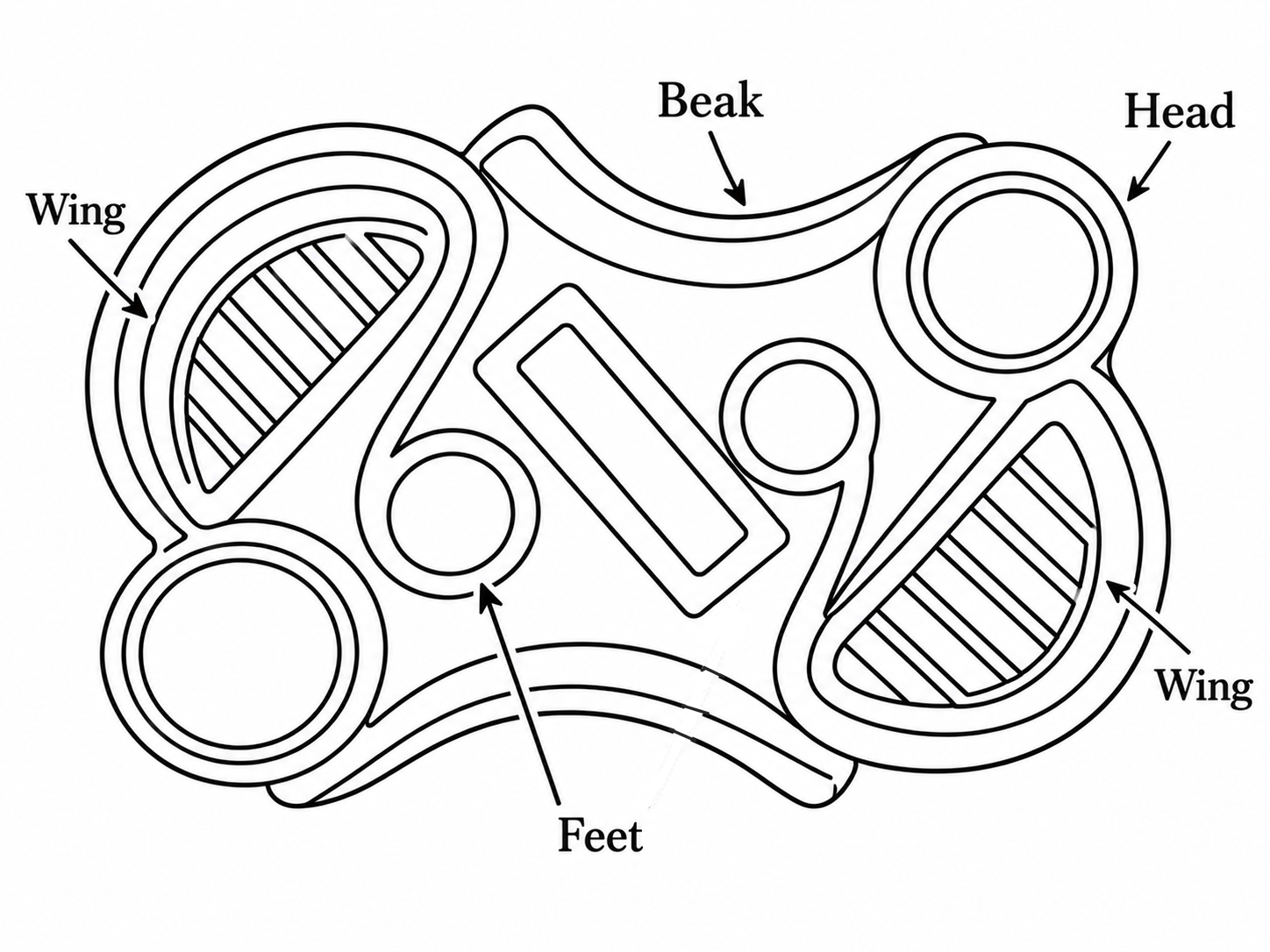
Wireframe showing the bird forms within the brooch design
The moment something clicked
I don't remember exactly what finally broke the search open. I have always been fascinated by archaeological discoveries—particularly those extraordinary hoards of objects that occasionally emerge from the ground—and I think I was looking at ancient jewellery for another reason when something caught my eye.
By then, after all that handling and looking, the strange ornament on my brooch had begun to resolve itself into something else.
Birds. Two of them.
And suddenly I was looking at ancient jewellery in an entirely different way.
Somewhere in that searching I found a tiny sixth-century object in the collection of the Metropolitan Museum of Art in New York. There they were.
What did they see?
But there is another question. Are the birds difficult for us to see because they were intended to be mysterious? Or because we no longer know how to look at them?
Related early medieval animal art developed a visual language in which creatures and hybrids could be fragmented, rearranged and embedded in ornament. Some images reveal themselves only after prolonged looking or when an object is turned. Ambiguity itself can be part of the design.[3] We are not fluent in that language.
A sixth-century viewer may have recognized forms instantly that take us minutes to disentangle. Perhaps particular animals, arrangements or materials carried associations that have become opaque to us. Some scholars have proposed that related animal imagery could carry protective, mythological or identity-related meanings, but interpreting a particular brooch as a talisman—or assigning these particular birds a specific meaning—would go beyond what the evidence can tell us.
That uncertainty interests me more than a convenient answer. Because whatever its precise meaning, somebody designed this.
And somebody saw something in it that spoke to them.

AI-generated image of a 6th-century woman wearing two fibulae to fasten her cloak
A Small Object, An Ancient World
How a brooch led me back nearly fifteen hundred years
There was something about this brooch that didn't belong.
I came across it among other objects, but visually it seemed to come from somewhere else. It was a pattern disruption: small, strange and difficult to place. Two red stones caught the light in a heavy gold-coloured surface. Around them was an intricate arrangement of curves, ridges, circles and projections that I couldn't make sense of.
Then I picked it up.
For something only about 1⅜ inches long, it had surprising weight—about three-quarters of an ounce—even though the back is partly hollowed. I wondered what it was made of. I wondered when it was made. Mostly, I wondered what I was looking at.
That was enough. I brought it home.
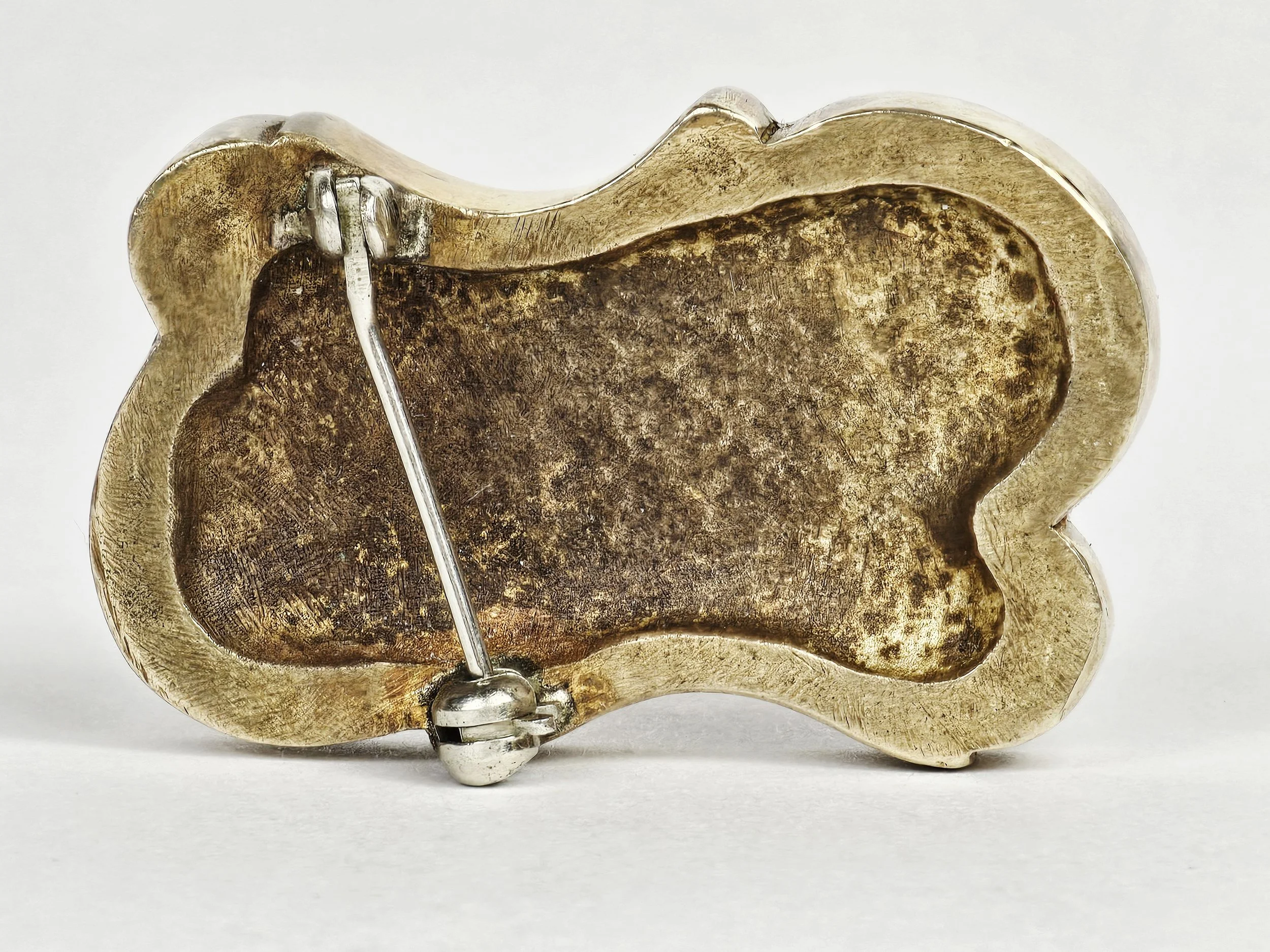
Back of my Brooch
Seeing the design
In fact, my brooch makes the creatures considerably easier to see. Whoever made it seems to have worked backwards through the old composition, asking, in effect: What is essential here?
The eyes become more obvious. The bodies are clarified. The ancient design's openings and complicated relationships are translated into a heavier, more immediately legible piece of jewellery.
Go back to the sixth-century brooch and the design becomes stranger. The birds begin to disappear. Eye becomes circle. Beak becomes curve. Wing and body become ribbed geometry. Two creatures are compressed and interlocked until animal and ornament are almost inseparable.
This was not simply an eccentric solution by one forgotten metalworker. Related S-shaped brooches survive in numerous variations. A late-sixth-century Merovingian example in the British Museum has opposing bird heads with grooved necks and circular eyes; Langobardic examples include birds of prey worked into still more elaborate S-shaped compositions. [2]
Research on related early medieval animal ornament has explored processes of abstraction and visual ambiguity. Scholars studying Anglo-Saxon Style I art have even argued that some designs were deliberately made to resist immediate recognition and to allow more than one visual reading. [3]
That was startling to discover, because it was precisely what had fascinated me before I knew any of this.
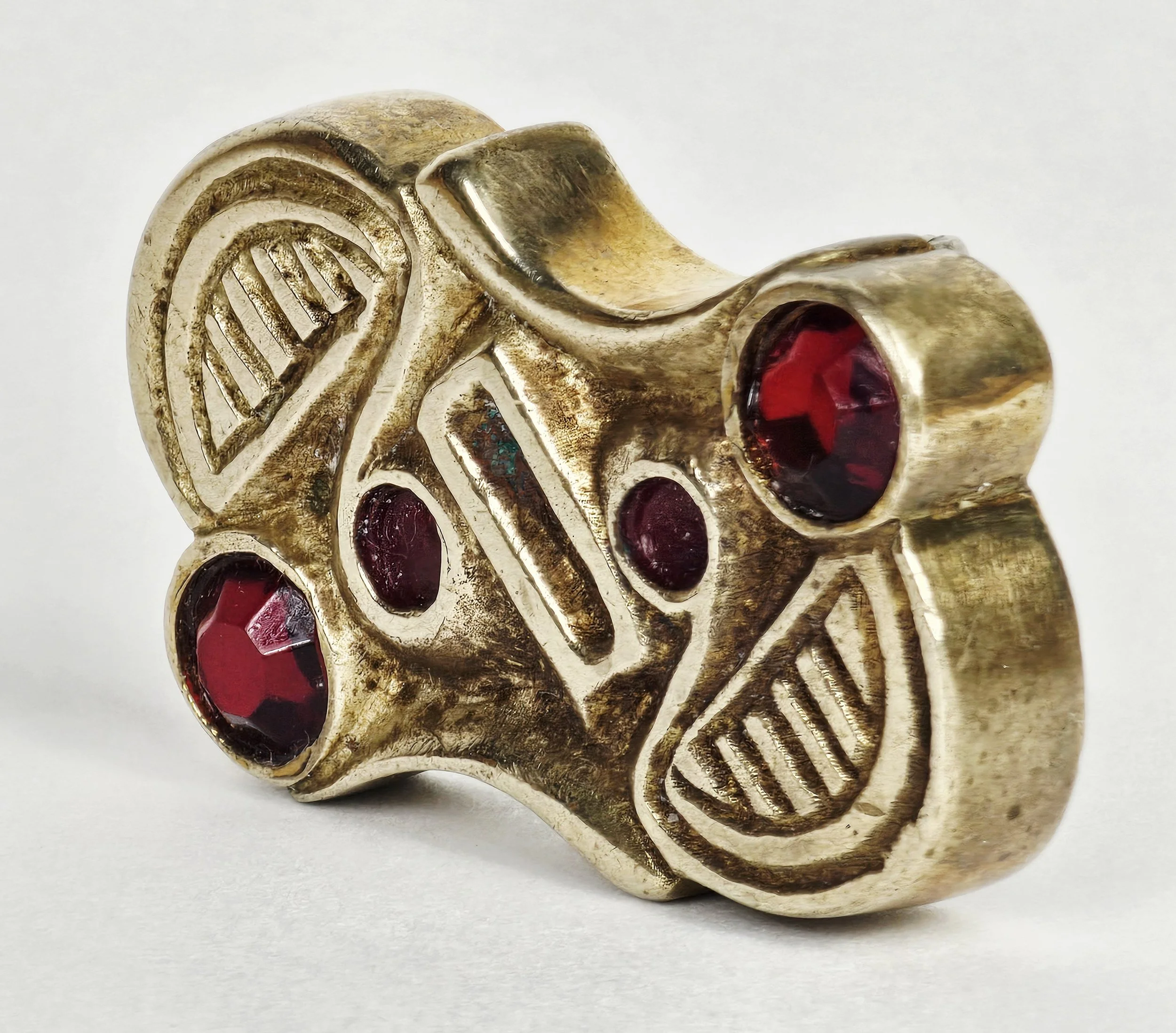
An angled view of my brooch, showing its raised and layered surface.
Adornment in her World
The ancient brooch is a typer world of fastening known as a fibula—a decorative pin used to secure clothing. It was not originally an archaeological object sitting motionless against a museum background. It was jewellery, and it was worn.
Brooches were characteristic elements of women's dress in this period. Frankish women wore small brooches in inventive forms during the fifth and sixth centuries, while archaeological evidence from Langobardic territories shows S-shaped brooches frequently occurring in pairs.[4] This was a world stretching across parts of what is now France , Belgium, Germany and, farther east and south, into the Danube region and northern Italy.
So remove the museum background for a moment and put the object back against cloth. Give it a human scale.
Imagine—not as a reconstruction of the Met brooch's particular owner, whom we cannot know, but as a historically plausible possibility—a woman dressing sometime in the sixth century. Her clothing has weight and texture. Small gilded brooches sit against the fabric.
She moves. And the metal catches the light. The red catches it differently and glints.
Garnet was used extensively in Frankish jewellery. In sophisticated cloisonné work, metalworkers placed textured gold foil beneath thin translucent garnets so that the pattern remained visible through the stone.[5] These were makers manipulating metal, colour, transparency and reflection on an extraordinarily small scale.
They were engineering light on a miniature scale. It was meant to be seen.
The fascination
We are encountering evidence of a design intelligence from nearly fifteen hundred years ago—but probably not the intelligence of one person alone. The visual vocabulary itself was inherited and transformed. Related designs moved between communities and workshops. Makers copied, altered, compressed and reassembled forms.[2]
The maker of my brooch encountered an ancient design and made an interpretation of it, preserving its essential components while making the design easier for us to see. In a sense, this is the same design process that had been happening centuries earlier.
I can now appreciate the later craftsman's reinterpretation of an ancient design, and recognize behind it a sixth-century metalworker shaping the brooch within a visual tradition inherited from others. And within that world, a woman wearing this arrangement of birds, red stones and reflected light—a design that belongs to the distant past, and now, in a very different way, to my present.
What if, for a moment, I stand in her place? Feel the weight of the cloth on my shoulders, the brooches holding it there, the air around me. Hear the language I speak. See the people I know, the community I belong to, the traditions and customs that make my world familiar to me. None of it is ancient. It is simply my present.
I imagine what these brooches meant to the woman who wore them. And this has added a richness to my brooch that I never expected, which thrills and fascinates me.
Sources
[1] The Metropolitan Museum of Art. S-Shaped Brooch, Frankish, 6th century. Silver, gilded silver, garnets, niello inlay, and iron pin. Accession 17.192.4. The Met — S-Shaped Brooch The Metropolitan Museum of Art
[2] The Metropolitan Museum of Art. Guide to Provincial Roman and Barbarian Metalwork and Jewelry; The British Museum, S-brooch, Nordendorf, late 6th century; National Museum of Slovenia, Jewellery, 6th century. These sources document the related Frankish and Langobardic S-shaped brooch tradition, opposing bird forms, and the numerous variants of the type.
[3] David Leigh. “Ambiguity in Anglo-Saxon Style I Art.” The Antiquaries Journal, vol. 64, no. 1 (1984), pp. 34–42. Leigh examines animal and human imagery designed to permit more than one visual reading, including forms that change according to viewing angle.
[4] The Metropolitan Museum of Art, collection research on Frankish women's dress and brooches; National Museum of Slovenia, Jewellery. The Met describes pairs of small brooches as characteristic elements of Frankish women's dress from the fourth through sixth centuries; the Slovenian museum records S-shaped brooches as typically Langobardic and usually worn in pairs. The Metropolitan Museum of Art +1
[5] The Metropolitan Museum of Art. Collection research on Frankish cloisonné jewellery. The Met describes the use of textured gold foil beneath thin translucent garnets, allowing the pattern beneath to remain visible through the stone.